Angry Birds 2
- 4.1
- Rating
- 100.00M
- Installs
- Free
- Price

 Analysis by App-foxy
I have always liked games that explain themselves in seconds, and Angry Birds 2 still fits that description beautifully. You pull back a bird, aim, release, and watch a structure collapse around the pigs. That simple loop makes it an easy choice for a short break, yet the game has enough variation to keep a familiar idea from feeling completely flat. After spending time with it, I see it as a casual game built more around quick decisions and repeated attempts than long, uninterrupted sessions.
It is free to download and play, which makes the first decision easy: you can try the core experience without paying upfront. The game is made by Rovio Entertainment Oy, carries an Everyone age rating, and belongs firmly to the casual category. Its large audience—over 100 million installs, with an average rating of 4.1 from around 6.3 million ratings—also tells me that its basic appeal is easy to understand, even if that does not automatically make every part of the experience ideal for every player.
How the slingshot experience works in everyday play
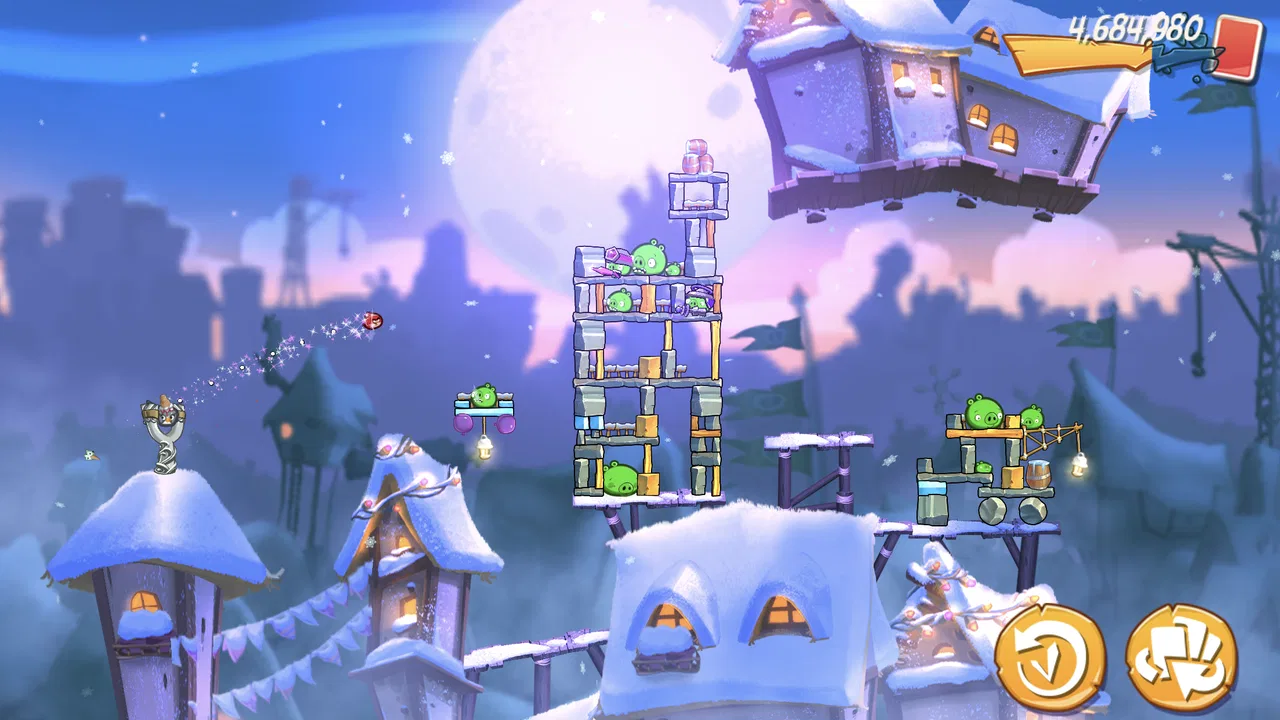
The strongest part of the game is the physical feeling of each launch. A small adjustment to the angle can change whether a bird hits a support, passes through an opening, or causes a chain reaction. I enjoy that the goal is not simply to throw birds at the most visible pig. The better approach is often to study the whole structure first and decide which piece will make everything else fall apart.
You May Also Like

 Pandora - Music & Podcasts
Pandora’s Music Is Easy to Start, but Harder to Recover
Pandora’s strength is its low-effort path from a seed to a station. Its weak spot is how much confidence it asks you to place in connection, setup, and quiet recovery.

 8 Ball Pool
 Is Built on Rivalries, Rematches, and Routine
A close look at the rivalries, rematches, shared routines, and unanswered safety questions that turn a quick pool match into a persistent mobile community.

 Samsung Music
’s Quiet Strength Is Playing What You Already Own
Its reach comes less from spectacle than from dependable access to a personal library. That simplicity is both the app’s strongest retention engine and its ceiling.

 AccuWeather: Weather Radar
AccuWeather Review: A Quick, Clear Forecast for Everyday Decisions
For everyday plans, the best forecast is the one you can understand quickly. AccuWeather makes rain timing, radar, and local conditions easy to act on, with a few trade-offs.

 Hill Climb Racing
Why Hill Climb Racing Still Turns Crashes Into One More Run
A tiny car, a bumpy hill and one more upgrade: Hill Climb Racing keeps resurfacing because its simple chaos makes every near-miss feel personal.

 AliExpress - Shopping App
AliExpress Makes Global Shopping Feel Personal, but Shoppers Bear the Risk
AliExpress turns a global marketplace into a pocket-sized discovery engine. Its reach is useful, its shopping loop compelling, and its trade-offs easy to miss.
More From Our News Desk
View All News


That makes each attempt feel like a compact puzzle. You are not solving a huge board with complicated instructions; you are reading materials, openings, supports, and bird abilities at a glance. The best moments come when a single well-placed shot does much more than expected. When a launch fails, the reason is usually understandable, which encourages me to try a different angle rather than blaming the controls.
The game is particularly comfortable in short sessions. I can play while waiting for an appointment, during a commute when conditions are safe for phone use, or at home when I want something lighter than a story-driven game. A level does not demand the same concentration as a competitive multiplayer match, but it still gives me a small problem to solve. That balance is the main reason I would recommend it to someone who wants casual entertainment without learning a complicated control system.
Offline play is an important practical strength. The ability to play without an active connection makes it more useful for travel, waiting rooms, and places where mobile service is unreliable. I would still pay attention to how the game behaves around account or purchase features, but for the basic reason many people install it—to launch birds and clear stages—the offline aspect makes it a better companion than casual games that depend on constant connectivity.
Why the birds make the familiar formula more interesting
The birds are not interchangeable projectiles. Choosing which one to use is part of the puzzle, and the order of your shots can matter as much as the direction of the first launch. I find myself looking for an opening that lets a bird’s particular behavior do useful work instead of spending the strongest option immediately.
This creates a small but meaningful layer of planning. A player who fires as quickly as possible may still clear a stage, but a player who pauses to inspect the layout usually gets more satisfying results. That is one of the less obvious strengths of the game: it rewards observation before action, even though the controls are simple enough for a child to understand.
My practical tip is to resist the urge to aim at the pig that looks easiest to reach. Look for the weakest support or the material holding several sections together. In many stages, the most efficient shot is the one that changes the structure rather than the one that directly reaches a target. This approach also reduces frustration because it turns a failed attempt into information about the level’s construction.
Another useful habit is to treat the first attempt as reconnaissance. Instead of expecting an immediate perfect result, I use it to learn how the structure reacts and where the important openings are. That is especially helpful when the level presents several possible routes. A cautious first shot can reveal more than a rushed attempt aimed at immediate destruction.
What the free price means in practice
Because the game is free, I think of it as a low-risk trial rather than a purchase decision. You can install it, learn the controls, and decide whether the rhythm suits you without committing money at the beginning. That matters for a casual title, since some players will enjoy the first few sessions but not want a game that asks for regular attention afterward.
There are optional in-app purchases ranging from $0.99 to $249.99 per item. The wide range is worth noticing, even if you never buy anything. Free access can be excellent value when you are comfortable progressing at your own pace, but it becomes less comfortable if you feel pushed toward spending to smooth out difficult moments or accelerate progress. I would approach the purchase system carefully, particularly on a shared family device.
My recommendation is to decide your spending boundary before playing. If you want a completely no-cost experience, treat every optional purchase as unnecessary and judge the game by what it gives you without paying. If you are willing to spend occasionally, remember that a low entry price does not mean every later purchase has equal value. The game can be enjoyable for free, but the presence of expensive individual items means it deserves the same spending discipline as any other free-to-play title.
This distinction is important: the verified price is free, while the optional purchase range reaches as high as $249.99 for an item. I cannot treat that upper figure as a normal cost of playing, and I would not describe the game as requiring it. It simply means parents and players should avoid assuming that “free” removes all financial considerations. The sensible value test is whether you are happy with the free loop first.
Where the design creates friction
The same repetition that makes the game relaxing can also become its main weakness. You are repeatedly aiming, launching, watching structures collapse, and trying again. I enjoy that rhythm in small doses, but it is not the right choice when I want deep character development, a long narrative, or a large world to explore. The game offers focused puzzle action rather than a broad adventure.
Difficulty can also feel personal. Some players will appreciate having to retry a stage and refine their aim; others will see repeated attempts as a sign that the game is wasting their time. If you dislike trial and error, the slingshot may become irritating even when the controls themselves are responsive. I would not recommend it to someone looking for a consistently calm experience with no pressure to improve.
The free-to-play structure is another trade-off. Even when the basic game is accessible, optional purchases can affect how a player thinks about progress. I prefer to play without spending and accept that some stages may require patience. That approach keeps the game closer to a casual pastime. Players who are easily tempted by boosters, extra chances, or convenience purchases should set device-level purchase protections before handing the game to a child.
The age rating is Everyone, which makes the presentation approachable for a broad audience. Still, an age rating does not replace supervision around spending. A child may understand the slingshot perfectly well without understanding that a tap can lead to a real charge. For family use, I would explain the purchase rules clearly and keep payment approval under adult control.
How it compares with other casual choices
Compared with a match-three game, this one gives me more direct control over the outcome. I am choosing a trajectory and watching the physical consequences, rather than mainly arranging identical pieces on a grid. That makes it better for players who enjoy spatial judgment and cause-and-effect reactions.
Compared with an endless runner, it is less about reflexes and more about planning. You can take a moment to inspect the structure before launching, so success does not depend entirely on rapid reactions. Someone who prefers constant movement and score chasing may find it slower, while someone who likes compact puzzles may prefer the breathing room.
Compared with a premium paid casual game, the free entry is more approachable, but the optional purchase model requires more awareness. A paid game can feel simpler to budget for because the main cost is decided at the start. Here, the advantage is that you can play before deciding whether the experience deserves any money. For me, that makes it a good first try, but not automatically the best long-term value for someone who dislikes in-app purchases.
It also sits between a pure puzzle game and a toy-like physics sandbox. The goal structure gives each stage purpose, while the collapsing towers provide the playful spectacle. That combination is why it remains accessible: you can focus on solving efficiently, or simply enjoy seeing an elaborate construction come down after a well-placed shot.
Useful ways to get more from each session
I get better results when I separate accuracy from efficiency. First, I look for a reliable way to reach the pigs. Then I consider whether another route could clear more of the structure with fewer birds. This prevents me from chasing a perfect result before I understand the stage.
I also avoid changing my plan after the bird is already in flight. Once the launch is committed, watching the result is more useful than wishing the angle were different. The next attempt should change one decision—height, timing, target material, or bird choice—so I can tell what actually improved the result.
For a short everyday session, I suggest playing a small number of stages and stopping while the game still feels satisfying. Because the loop is repetitive by design, long sessions can make its weaknesses more noticeable. Used as a five-minute distraction or a brief puzzle break, it shows its best qualities more clearly than when treated as an all-day game.
For families, I would make the first session a shared one. Show younger players how to inspect the structure, explain that not every purchase is part of normal play, and agree that asking before spending is required. That turns the game into a simple exercise in planning and patience instead of only a source of quick screen stimulation.
Device details and who should install it
The game was released on July 23, 2015, and the current version is 7.1.0. It supports devices running Android 7.0 or later. Those details make it relevant to people using older compatible phones, although actual comfort will still depend on the device and how smoothly it handles the game.
I think it is a strong fit for casual players who like physics-based puzzles, short offline sessions, and familiar controls. It is also suitable for someone introducing a child to simple mobile games, provided purchases are managed by an adult. The Everyone rating supports its broad presentation, but responsible supervision remains more important than the label alone.
I would skip it if you want a one-time paid experience with no optional spending decisions, a substantial story, or a game that changes dramatically from session to session. I would also skip it if repeated retries make you impatient. In those cases, a premium puzzle game with a fixed price may offer a cleaner experience, while a narrative game may provide more variety and emotional investment.
My final recommendation
My view is straightforward: install it if you want an accessible casual game that turns aiming and structural collapse into quick, readable puzzles. The free entry makes trying it sensible, and offline play gives it genuine everyday usefulness rather than limiting it to strong Wi-Fi moments.
The important condition is how you handle the purchase model. I would play the free experience first, set a firm spending limit, and avoid treating optional items as necessary for enjoyment. If you can accept occasional repetition and enjoy learning from failed shots, the game delivers plenty of satisfying moments without demanding a complicated commitment.
Rovio Entertainment Oy has built a game whose appeal is easy to understand but still rewards careful play. I like it best when I approach each stage as a small engineering problem: inspect the supports, choose the right bird, and let one good decision create the collapse. For a free casual game, that combination of immediate fun, offline convenience, and light strategic thinking makes it worth trying—provided you are comfortable with its free-to-play trade-offs.
FAQs for Angry Birds 2
01What are the main features of Angry Birds 2?
Angry Birds 2 offers a range of exciting features, including multi-stage levels, daily challenges, and new spells. Players can also engage in PvP battles in the Arena, join clans, and participate in events. The game introduces new birds and allows players to choose which bird to launch for strategic gameplay.
02Is Angry Birds 2 free to play?
Yes, Angry Birds 2 is free to download and play. However, it contains in-app purchases that allow players to buy gems and other in-game items. These purchases can enhance gameplay and help players progress faster, but they are entirely optional and not necessary to enjoy the full experience.
03What devices are compatible with Angry Birds 2?
Angry Birds 2 is available on both Android and iOS platforms. For Android, it requires version 5.0 and up, while iOS requires version 11.0 or later. It’s compatible with iPhone, iPad, and iPod touch. Ensure your device meets these requirements for an optimal gaming experience.
04Does Angry Birds 2 require an internet connection?
While Angry Birds 2 can be played offline, an internet connection is necessary for certain features such as daily challenges, PvP battles, and joining clans. Connecting to the internet also allows access to updates and special events, providing a richer and more engaging gaming experience.
05How can I save my progress in Angry Birds 2?
To save your progress in Angry Birds 2, you can connect the game to your Facebook account or your Google Play (for Android) or Game Center (for iOS) accounts. This connection ensures your game progress is backed up and can be restored if you switch devices or reinstall the game.
Pros
- Stunning graphics and vibrant colors.
- Challenging levels with diverse designs.
- Regular updates with new content.
- Fun multiplayer competitions.
- Intuitive controls for easy gameplay.
Cons
- In-app purchases can be costly.
- Ads can interrupt gameplay.
- Requires internet for some features.
- Limited lives can halt progress.
- Battery consumption is high.

Angry Birds 2
Gallery